Augmented matrix: Difference between revisions
en>Ankit Maity m Reverted edits by 175.141.244.59 (talk) to last revision by ClueBot NG (HG) |
|||
| Line 1: | Line 1: | ||
They | {| class=wikitable align="right" | ||
!bgcolor=#e7dcc3 colspan=2|Chamfered cube | |||
|- | |||
|align=center colspan=2|[[Image:Truncated rhombic dodecahedron.png|240px|Chamfered cube]] | |||
|- | |||
|bgcolor=#e7dcc3|Type||[[Conway polyhedron notation|Conway polyhedron]]: cC = t4daC | |||
|- | |||
|bgcolor=#e7dcc3|[[Goldberg polyhedron]]||G<sub>IV</sub>(2,0) | |||
|- | |||
|bgcolor=#e7dcc3|Faces||6 [[square (geometry)|square]]s<BR>12 [[hexagon]]s | |||
|- | |||
|bgcolor=#e7dcc3|Edges||48 (2 types) | |||
|- | |||
|bgcolor=#e7dcc3|Vertices||32 (2 types) | |||
|- | |||
|bgcolor=#e7dcc3|[[Vertex configuration]]||(24) 4.6.6<BR>(8) 6.6.6 | |||
|- | |||
|bgcolor=#e7dcc3|[[List of spherical symmetry groups|Symmetry]]||[[octahedral symmetry|''O''<sub>''h''</sub>]], [4,3], (*432) | |||
|- | |||
|bgcolor=#e7dcc3|[[Dual polyhedron]]||[[Tetrakis cuboctahedron]] | |||
|- | |||
|bgcolor=#e7dcc3|Properties||[[convex set|convex]], [[zonohedron]], [[equilateral]]-faced | |||
|} | |||
[[Image:Truncated rhombic dodecahedron net.png|250px|thumb|[[net (polyhedron)|A net for chamfered cube]]]] | |||
The '''[[chamfer]]ed cube''' (also called '''truncated rhombic dodecahedron''') is a [[convex polygon|convex]] [[polyhedron]] constructed from the [[rhombic dodecahedron]] by [[Truncation (geometry)|truncating]] the 6 (order 4) vertices. | |||
The 6 vertices are truncated such that all edges are equal length. The original 12 [[rhombus|rhombic]] faces become flattened hexagons, and the truncated vertices become squares. | |||
The hexagonal faces are [[equilateral]] but not [[regular polygon|regular]]. They are formed by a truncated rhombus, have 2 internal angles of about 109.47 degrees (''arccos(-1/3)'') and 4 internal angles of about 125.26 degrees, while a regular hexagon would have all 120 degree angles. | |||
Because all its faces have an even number of sides with 180 degree rotation symmetry, it is a [[zonohedron]]. It is also the [[Goldberg polyhedron]] G<sub>IV</sub>(2,0), containing square and hexagonal faces. | |||
== Coordinates == | |||
The ''chamfered cube'' is the [[Minkowski sum]] of a rhombic dodecahedron and a cube of side length 1 when | |||
eight vertices of the rhombic dodecahedron are at <math>(\pm 1, \pm 1, \pm 1)</math> and its | |||
six vertices are at the permutations of <math>(\pm 2, 0, 0)</math>. | |||
== Related polyhedra == | |||
This polyhedron is similar to the uniform [[truncated octahedron]]: | |||
{| class="wikitable" | |||
!Truncated rhombic dodecahedron<BR>[[Image:Truncated rhombic dodecahedron2.png|120px]] | |||
!Truncated octahedron<BR>[[Image:Truncated octahedron.png|120px]] | |||
|} | |||
This polyhedron is also a part of a sequence of truncated rhombic polyhedra and tilings with [n,3] [[Coxeter group]] symmetry. The cube can be seen as a rhombic hexahedron where the rhombi are squares. The truncated forms have regular n-gons at the truncated vertices, and nonregular hexagonal faces. The sequence has two vertex figures (n.6.6) and (6,6,6). The hexagonal tiling can be considered a truncated [[rhombille tiling]]. | |||
{| class="wikitable" width=500 | |||
!colspan=3|Polyhedra | |||
!Euclidean tiling | |||
!colspan=2|Hyperbolic tiling | |||
|- | |||
![3,3] | |||
![4,3] | |||
![5,3] | |||
![6,3] | |||
![7,3] | |||
![8,3] | |||
|- align=center valign=top | |||
|[[File:Hexahedron.svg|100px]]<BR>[[Cube]] | |||
|[[File:Rhombicdodecahedron.jpg|100px]]<BR>[[Rhombic dodecahedron]] | |||
|[[File:Rhombictriacontahedron.jpg|100px]]<BR>[[Rhombic triacontahedron]] | |||
|[[File:Rhombic star tiling.png|100px]]<BR>[[Rhombille]] | |||
|[[File:Order73 qreg rhombic til.png|100px]] | |||
|[[File:Uniform dual tiling 433-t01-yellow.png|100px]] | |||
|- align=center valign=top | |||
|[[File:Alternate truncated cube.png|100px]]<BR>[[Alternate truncated cube]] | |||
|[[File:Truncated rhombic dodecahedron2.png|100px]]<BR>Truncated rhombic dodecahedron | |||
|[[File:Truncated rhombic triacontahedron.png|100px]]<BR>[[Truncated rhombic triacontahedron]] | |||
|[[File:Truncated rhombille tiling.png|100px]]<BR>[[Hexagonal tiling]] | |||
| | |||
|} | |||
=== Rhombic dodecahedron === | |||
The name ''truncated rhombic dodecahedron'' is ambiguous since only 6 (order-4) vertices were truncated. A truncation on just the 3-vertices of the rhombic dodecahedron would cause an icosahedron with 12 equilateral hexagons and 20 triangles, forming 30 vertices in total; this figure's dual can be called the ''triakis cuboctahedron''. Another alternate truncated rhombic dodecahedron can appear by truncating all 14 vertices, yielding 12 irregular octagonal faces. The dual of the full truncation is a triangular tetracontaoctahedron labeled the ''tritetrakis cuboctahedron'', which is a complete [[Kleetope]] of the [[cuboctahedron]]. The [[tetrahedron]] is to the [[truncated cube]] as the [[cube]] is to the full truncation or a bitruncated cuboctahedron. | |||
<gallery> | |||
File:rhombic dodecahedron.png|Rhombic dodecahedron | |||
Image:StellaTruncRhombicDodeca.png|Full truncation of rhombic dodecahedron | |||
Image:Truncated rhombic dodecahedron2.png|Order-4 truncation of rhombic dodecahedron<BR>(Chamfered cube) | |||
File:Chamfered_octahedron.png|Order-3 truncation of rhombic dodecahedron<BR>(Chamfered octahedron) | |||
</gallery> | |||
== See also == | |||
* [[Chamfered tetrahedron]] | |||
* [[Chamfered dodecahedron]] | |||
* [[Near-miss Johnson solid]] | |||
== References== | |||
* Antoine Deza, Michel Deza, Viatcheslav Grishukhin, ''Fullerenes and coordination polyhedra versus half-cube embeddings'', 1998 [[PDF]] [http://www.cas.mcmaster.ca/~deza/dm1998.pdf] | |||
== External links == | |||
* [[VRML]] model [http://www.georgehart.com/virtual-polyhedra/vrml/zono-7_from_cube.wrl] | |||
** [http://www.georgehart.com/virtual-polyhedra/conway_notation.html VTML polyhedral generator] Try "t4daC" ([[Conway polyhedron notation]]) | |||
{{Near-miss Johnson solids navigator}} | |||
[[Category:Zonohedra]] | |||
Revision as of 18:51, 18 October 2013
| Chamfered cube | |
|---|---|

| |
| Type | Conway polyhedron: cC = t4daC |
| Goldberg polyhedron | GIV(2,0) |
| Faces | 6 squares 12 hexagons |
| Edges | 48 (2 types) |
| Vertices | 32 (2 types) |
| Vertex configuration | (24) 4.6.6 (8) 6.6.6 |
| Symmetry | Oh, [4,3], (*432) |
| Dual polyhedron | Tetrakis cuboctahedron |
| Properties | convex, zonohedron, equilateral-faced |

The chamfered cube (also called truncated rhombic dodecahedron) is a convex polyhedron constructed from the rhombic dodecahedron by truncating the 6 (order 4) vertices.
The 6 vertices are truncated such that all edges are equal length. The original 12 rhombic faces become flattened hexagons, and the truncated vertices become squares.
The hexagonal faces are equilateral but not regular. They are formed by a truncated rhombus, have 2 internal angles of about 109.47 degrees (arccos(-1/3)) and 4 internal angles of about 125.26 degrees, while a regular hexagon would have all 120 degree angles.
Because all its faces have an even number of sides with 180 degree rotation symmetry, it is a zonohedron. It is also the Goldberg polyhedron GIV(2,0), containing square and hexagonal faces.
Coordinates
The chamfered cube is the Minkowski sum of a rhombic dodecahedron and a cube of side length 1 when eight vertices of the rhombic dodecahedron are at and its six vertices are at the permutations of .
Related polyhedra
This polyhedron is similar to the uniform truncated octahedron:
| Truncated rhombic dodecahedron Error creating thumbnail: |
Truncated octahedron File:Truncated octahedron.png |
|---|
This polyhedron is also a part of a sequence of truncated rhombic polyhedra and tilings with [n,3] Coxeter group symmetry. The cube can be seen as a rhombic hexahedron where the rhombi are squares. The truncated forms have regular n-gons at the truncated vertices, and nonregular hexagonal faces. The sequence has two vertex figures (n.6.6) and (6,6,6). The hexagonal tiling can be considered a truncated rhombille tiling.
| Polyhedra | Euclidean tiling | Hyperbolic tiling | |||
|---|---|---|---|---|---|
| [3,3] | [4,3] | [5,3] | [6,3] | [7,3] | [8,3] |
| File:Hexahedron.svg Cube |
File:Rhombicdodecahedron.jpg Rhombic dodecahedron |
File:Rhombictriacontahedron.jpg Rhombic triacontahedron |
File:Rhombic star tiling.png Rhombille |
File:Order73 qreg rhombic til.png | File:Uniform dual tiling 433-t01-yellow.png |
| File:Alternate truncated cube.png Alternate truncated cube |
Error creating thumbnail: Truncated rhombic dodecahedron |
File:Truncated rhombic triacontahedron.png Truncated rhombic triacontahedron |
File:Truncated rhombille tiling.png Hexagonal tiling |
||
Rhombic dodecahedron
The name truncated rhombic dodecahedron is ambiguous since only 6 (order-4) vertices were truncated. A truncation on just the 3-vertices of the rhombic dodecahedron would cause an icosahedron with 12 equilateral hexagons and 20 triangles, forming 30 vertices in total; this figure's dual can be called the triakis cuboctahedron. Another alternate truncated rhombic dodecahedron can appear by truncating all 14 vertices, yielding 12 irregular octagonal faces. The dual of the full truncation is a triangular tetracontaoctahedron labeled the tritetrakis cuboctahedron, which is a complete Kleetope of the cuboctahedron. The tetrahedron is to the truncated cube as the cube is to the full truncation or a bitruncated cuboctahedron.
-
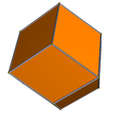 Rhombic dodecahedron
 -
 Full truncation of rhombic dodecahedron
 -
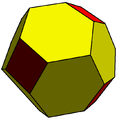 Order-4 truncation of rhombic dodecahedron
(Chamfered cube) -
 Order-3 truncation of rhombic dodecahedron
(Chamfered octahedron)


See also
References
- Antoine Deza, Michel Deza, Viatcheslav Grishukhin, Fullerenes and coordination polyhedra versus half-cube embeddings, 1998 PDF [1]
External links
- VRML model [2]
- VTML polyhedral generator Try "t4daC" (Conway polyhedron notation)